2022 | BKLN
A platform to empower Financial Advisors
BKLN Investment Group is building a digital platform to offer personalized portfolios tools for FInancial Advisors to offer robust portfolio planning and management for clients. The platform offers institutional-grade portfolio optimization and automated tax-loss harvesting.
In the past five years, BKLN platform has developed a strong AI engine that customizes investment portfolios, leading to over $5 billion in trades.
The project aimed to transform the wealth management industry by creating a responsive web platform for BKLN Investment Group. The goal was to provide financial advisors with advanced tools to excel in the digital age, manage client relationships efficiently, manage scheduling and use AI-driven personalization for portfolio modeling.
Role
User Experience Designer
Deliverables
Primary and Secondary Research, Information Architecture, User Flows, Wireframes, Prototyping, and Usability Testing.
Team
Lead Design, Product Owner, Engineering Team
Duration
12 Weeks
The Problem
Financial advisors struggle to manage client investments and relationships.
Difficulty staying updated on market trends and making data-driven choices.
Manual tasks and processes limit advisor capacity to handle more clients.
The Outcome
Centralized platform for managing wealth and client relationships.
Real-time data analysis and insights for informed decision-making.
Streamlined workflows and automated tasks for increased efficiency.
Greater client capacity through streamlined onboarding and enhanced management
The Outcome
Simplified Onboarding: Step-by-step process guides advisors, efficiently collecting and organizing client information.
Streamlined Portfolio Management: User-friendly tools empower informed decision-making with clear insights.
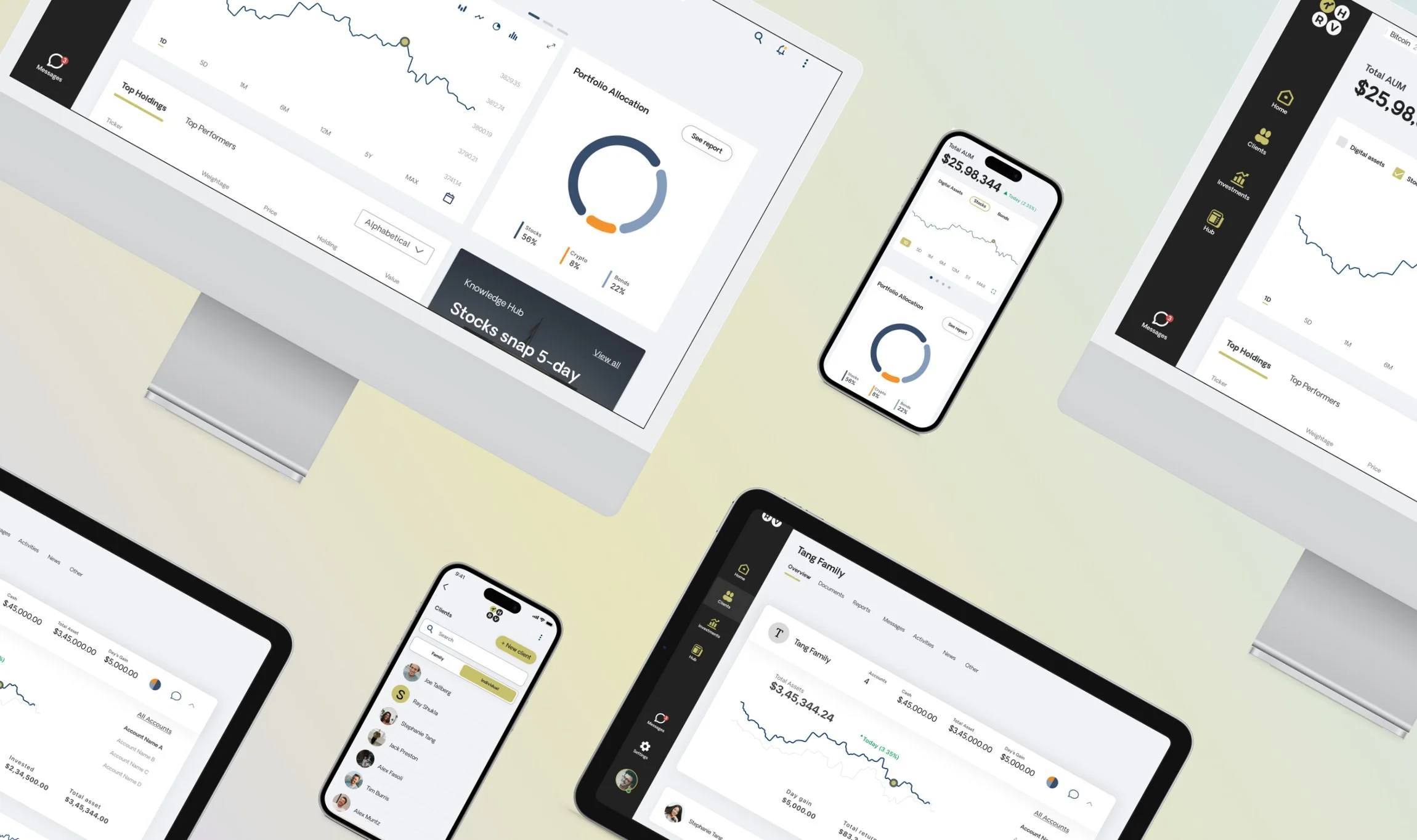
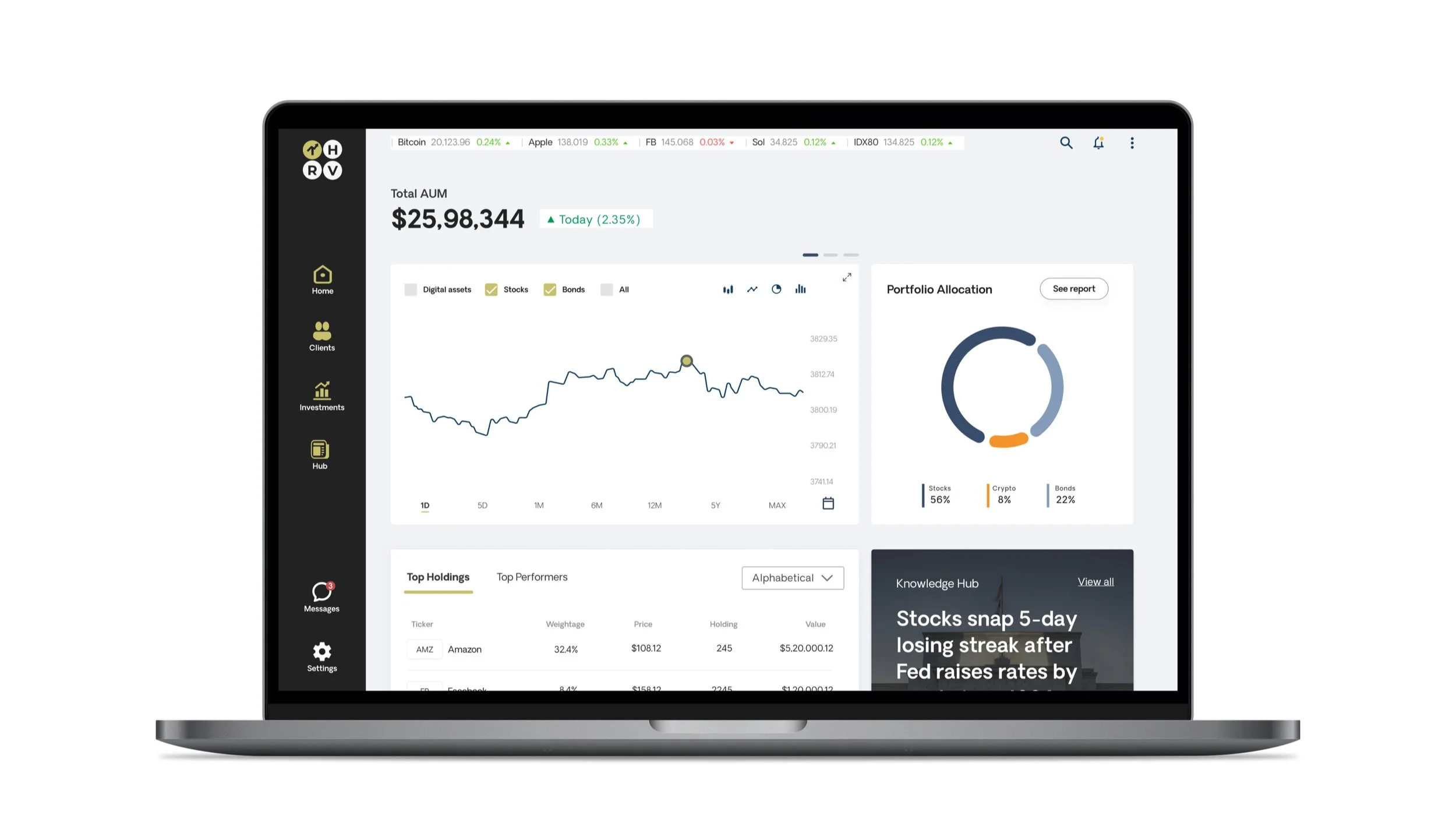
Dashboard: The Ultimate Command Center
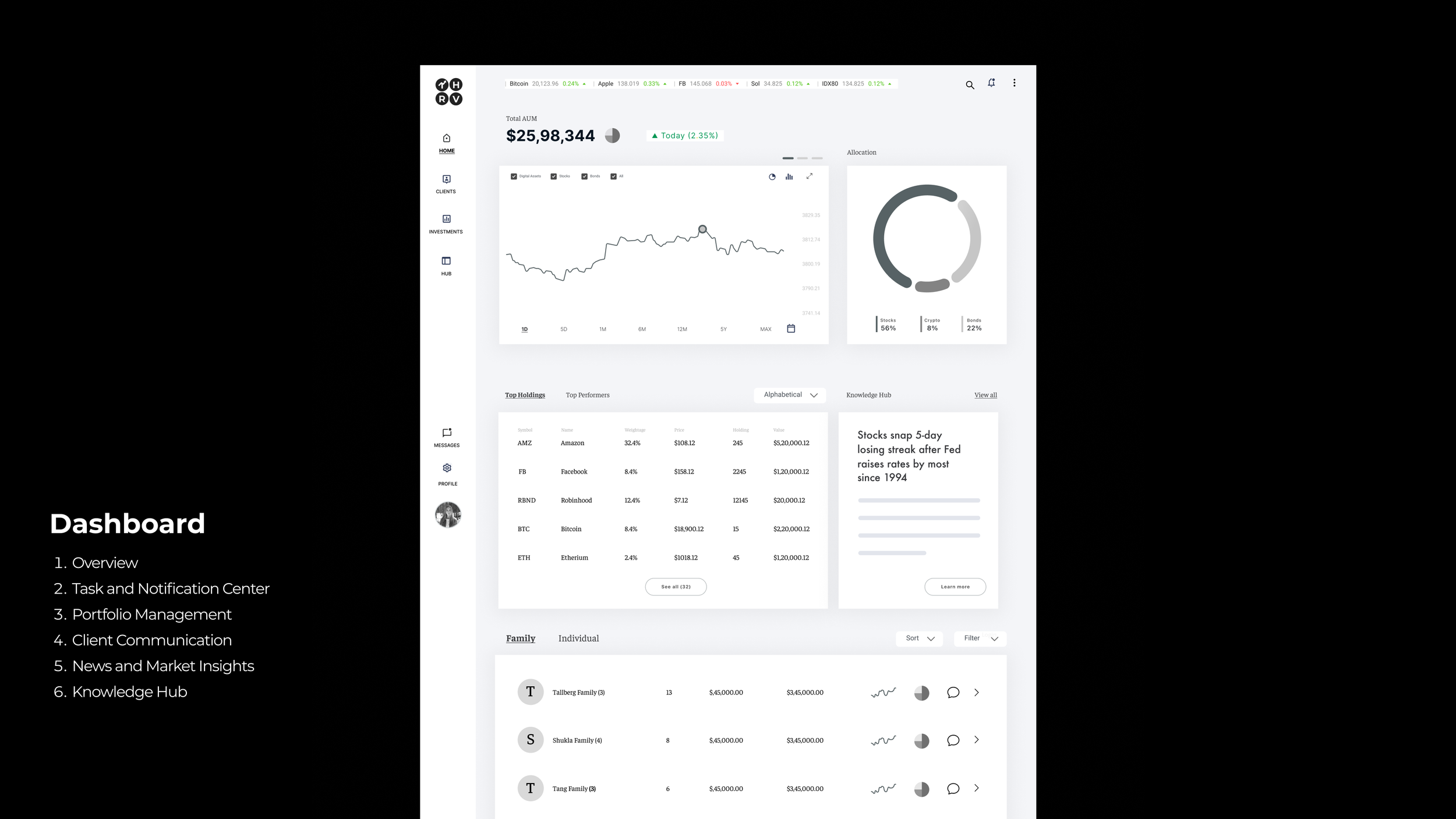
Advisors can fully customize content blocks to suit their workspace preferences, enhancing productivity and enabling informed decision-making. This customizable solution empowers advisors to efficiently manage portfolios, stay updated on market trends, and engage clients effectively.
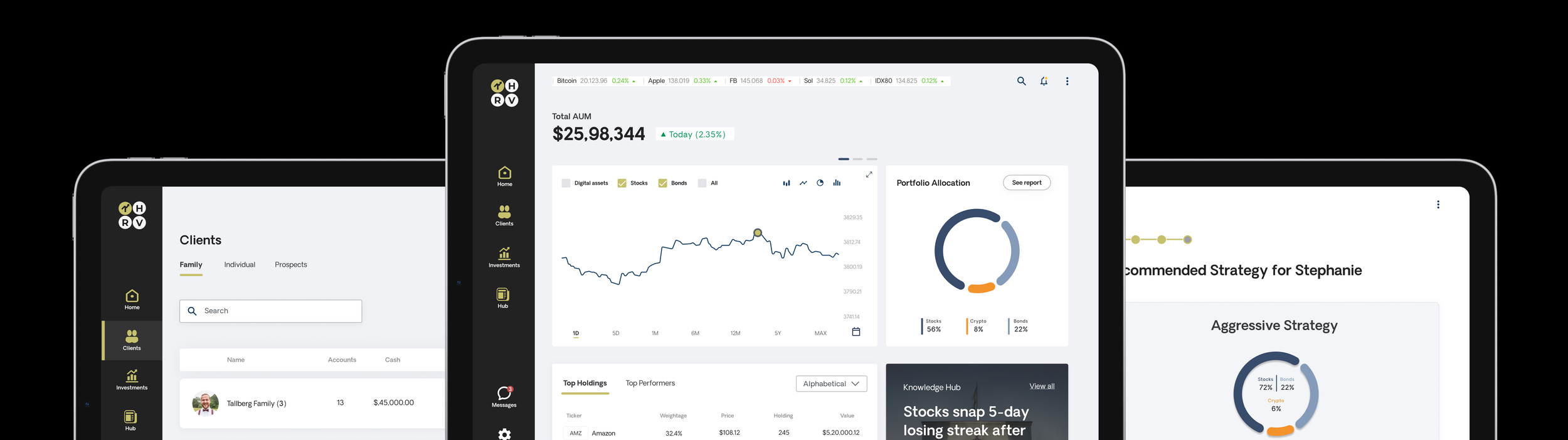
Streamlined Client Management for Informed Decision-Making
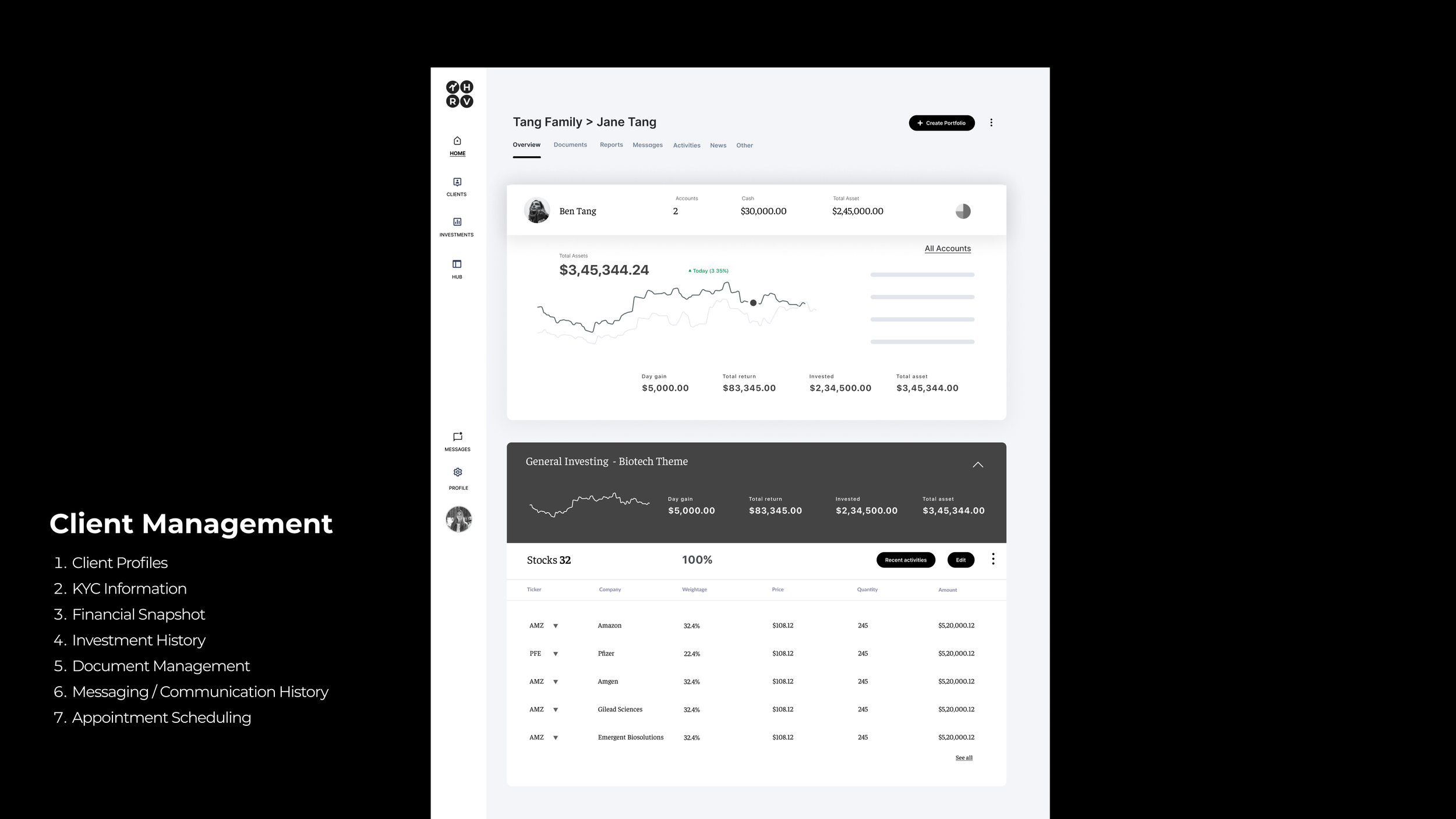
The Client Management feature centralizes all client data, streamlining documentation, reports, and communication. Investment advisors can efficiently create and manage client profiles and requirements, enabling quick, informed decision-making for better personalized financial strategies.
Personalized Portfolio modelling
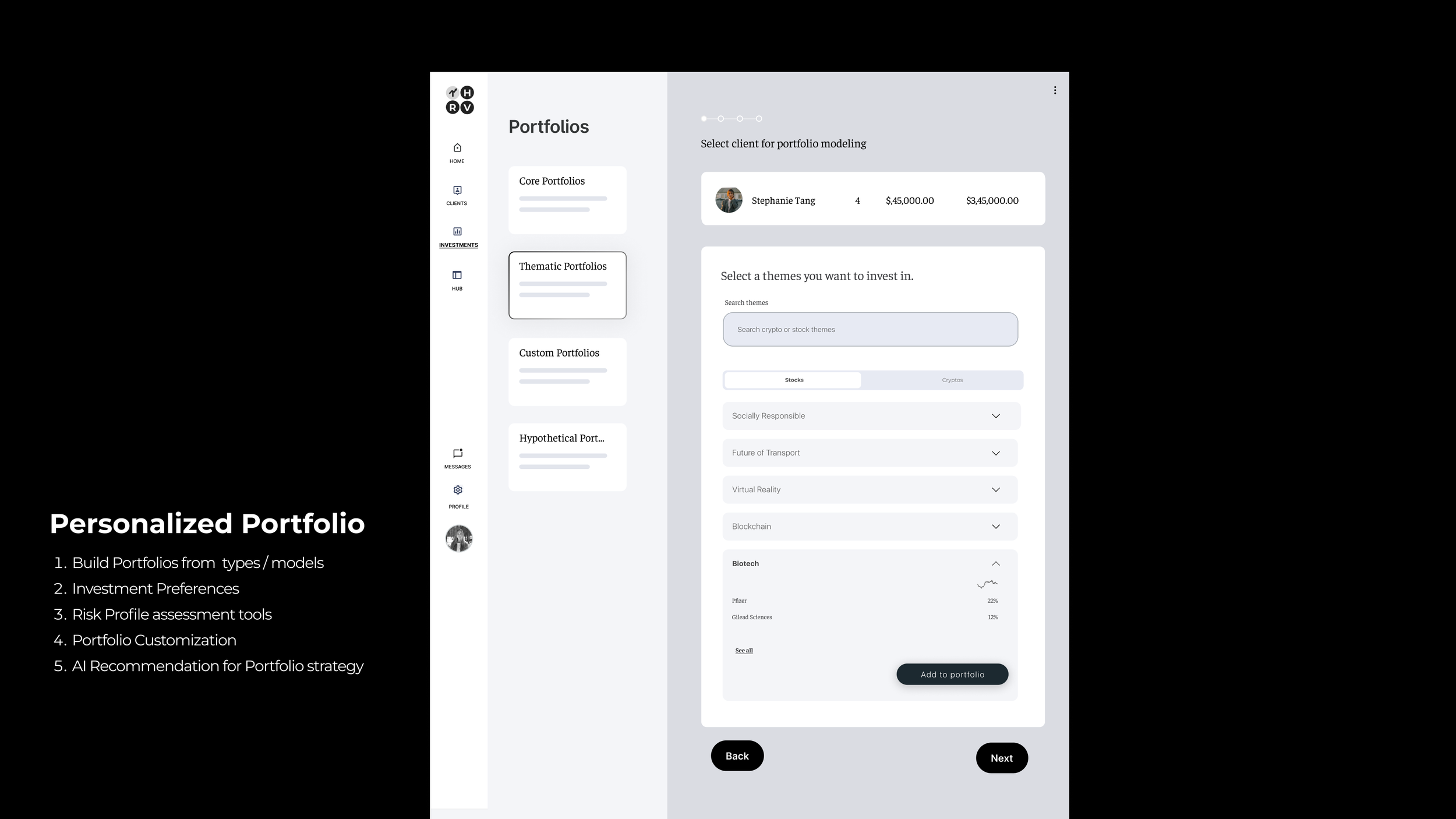
Build, customize, personalize or choose from the core theme to model Investment portfolio or simply input your preference and let AI recommend Portfolio strategy.
PROCESS
My design process began with a thorough exploration of the financial advisor's world, focusing on their unique needs and workflow. This informed the creation of user-friendly wireframes and interactive prototypes, with continuous advisor feedback shaping the designs. After finalizing the design, we developed and tested the responsive platform.
Post-launch, ongoing monitoring and user feedback have been key in refining the platform. Clear documentation and dedicated support ensure it remains a dynamic, user-centric tool for financial advisors.
1. Research
2. Define
3. Ideate
4. Prototype
5. Test
01 / Research
I started my research process to understand the financial industry and Brooklyn’s potential role. Initially focused on AI-driven investing and the B2C market, our research with business stakeholders showed greater potential in empowering independent advisors in a B2B context.
To build strong customer empathy, I explored the needs, challenges, and opportunities of financial advisors and their clients. My strategy included setting research goals, interviewing financial advisors, experts, and clients, engaging with stakeholders, and conducting secondary research.
SECONDARY RESEARCH
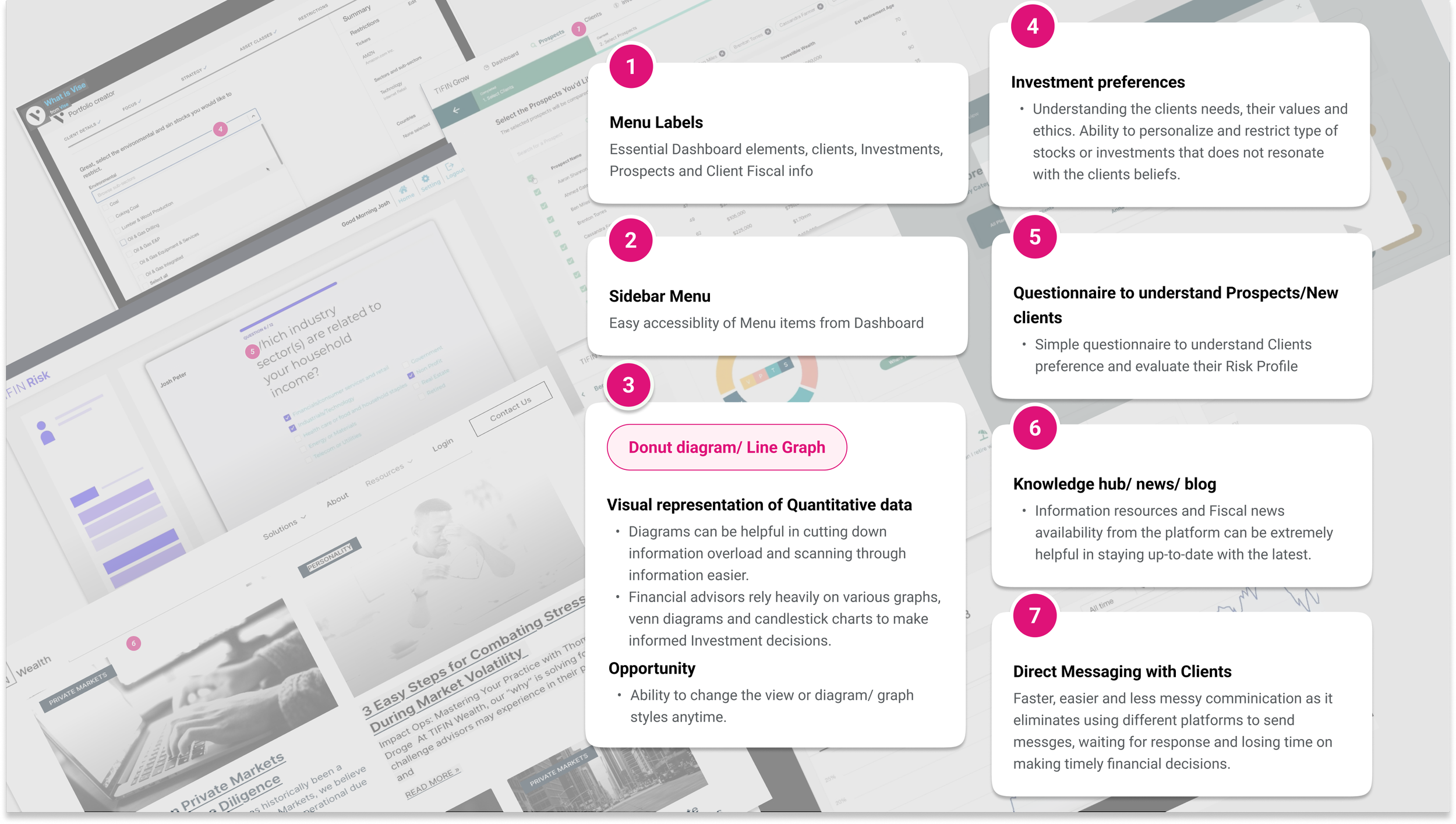
Understanding the Space - I initiated my research journey with a targeted competitive analysis, scrutinizing both Direct and Indirect Competitors' web platforms. This audit aimed to uncover their business offerings, features, information structures, and overall product journeys. By meticulously annotating pivotal interaction points, user experiences, and visual design elements, I pinpointed the essence of creating a product that resonates with delight and significance.
Secondary Market research
Service feature audit
INTERVIEWS
Building Customer Empathy - I conducted in-depth interviews with stakeholders, users, and their clients. Although the platform mainly serves advisors, it was vital to understand clients' needs, preferred tools, and challenges with investment platforms and non-traditional advisory services. These interviews provided valuable insights into how to enhance the user experience.
The primary goals of the user
The users pain points with managing multiple clients and growing their business
The opportunities that the platform can leverage on
The pain points and frustrations of the clients that the user manages when it comes to investing.
ANALYSIS AND SYNTHESIS
The Affinity Map gave a visual summary of the pain points and the potential immediate and future opportunities to enhance the product and analyzing product feature ideas in early design ideation.
KEY RESEARCH LEARNINGS
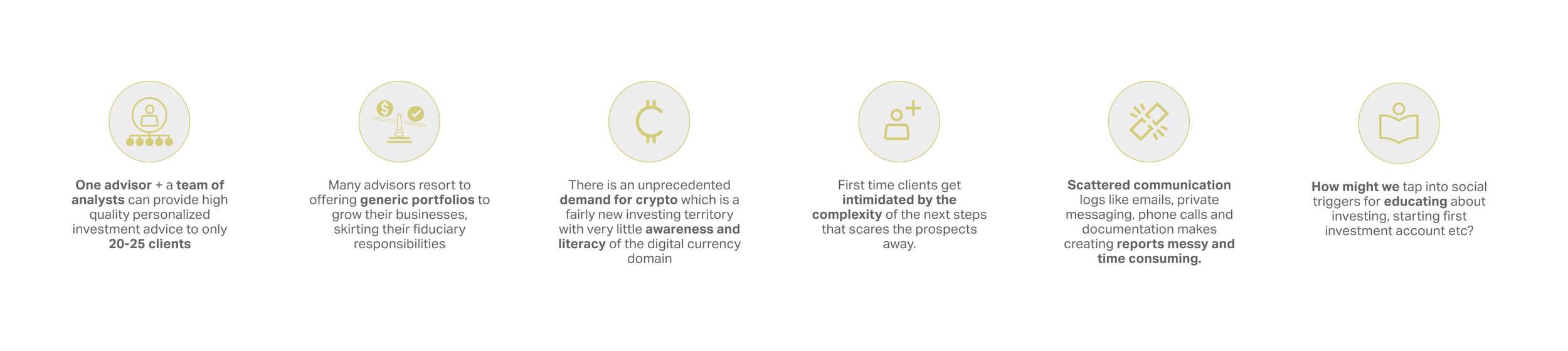
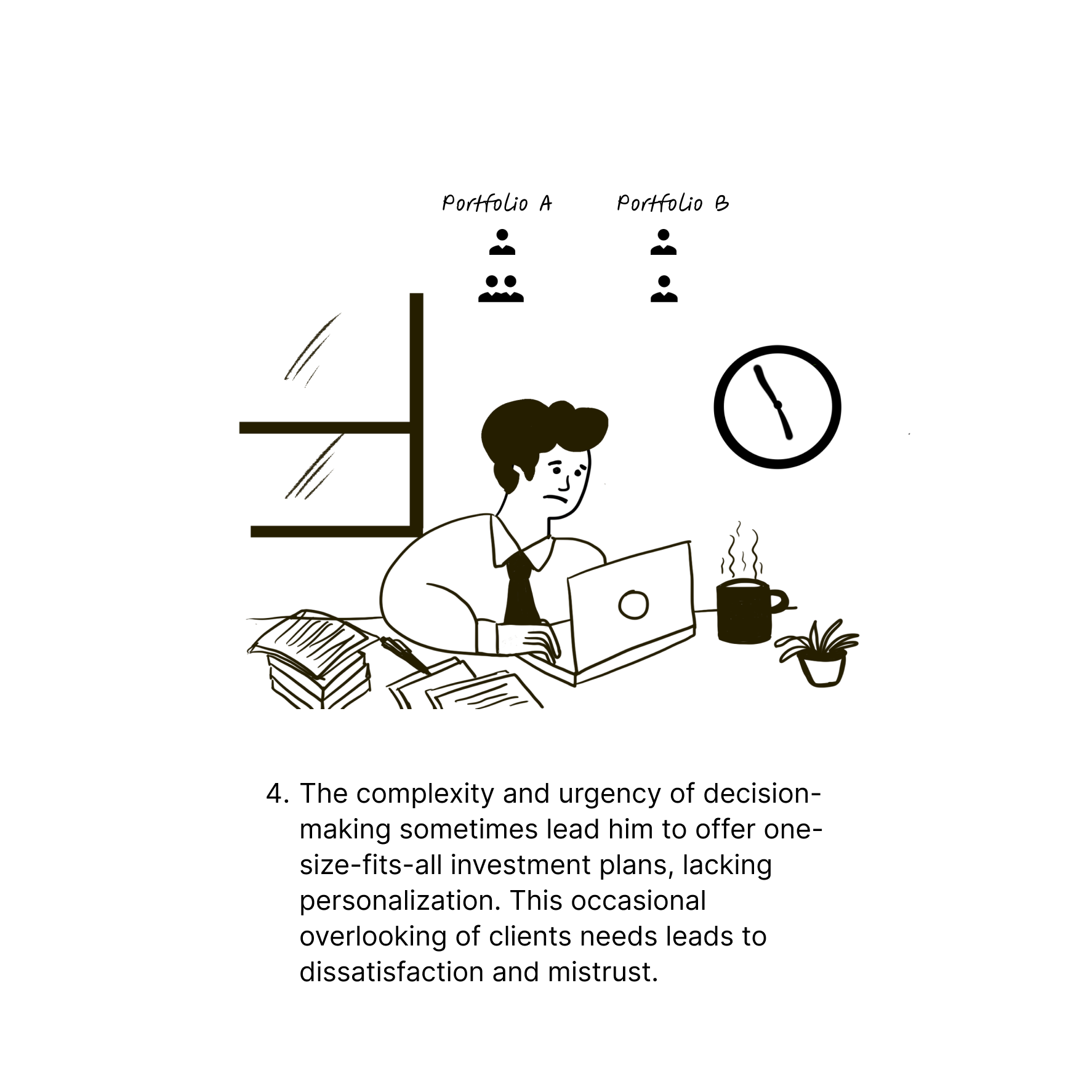
Personalization is key for advisors for continued client engagement when it comes to investing. But most financial advisors are unable to scale personalized advice.
These observations uncovered some Industry and market frustrations but I also gathered some key insights on the frustrations and challenges of the user when it comes to managing investment needs of the clients and to provide service efficiently.
02 / Define
In the Define phase of the project, the main goal was to understand the users deeply and refine the findings as we synthesized our research insights. By grasping the unique behaviors, challenges, and aspirations of our target users, we defined features and content tailored to their needs. Through collaboration with stakeholders, we established the core elements of our Minimum Viable Product (MVP), ensuring each component was purposeful, user-friendly, and aimed at improving the user experience. This phase laid the groundwork for developing a solution that delights and empowers users on their financial journeys.
PERSONA CREATION
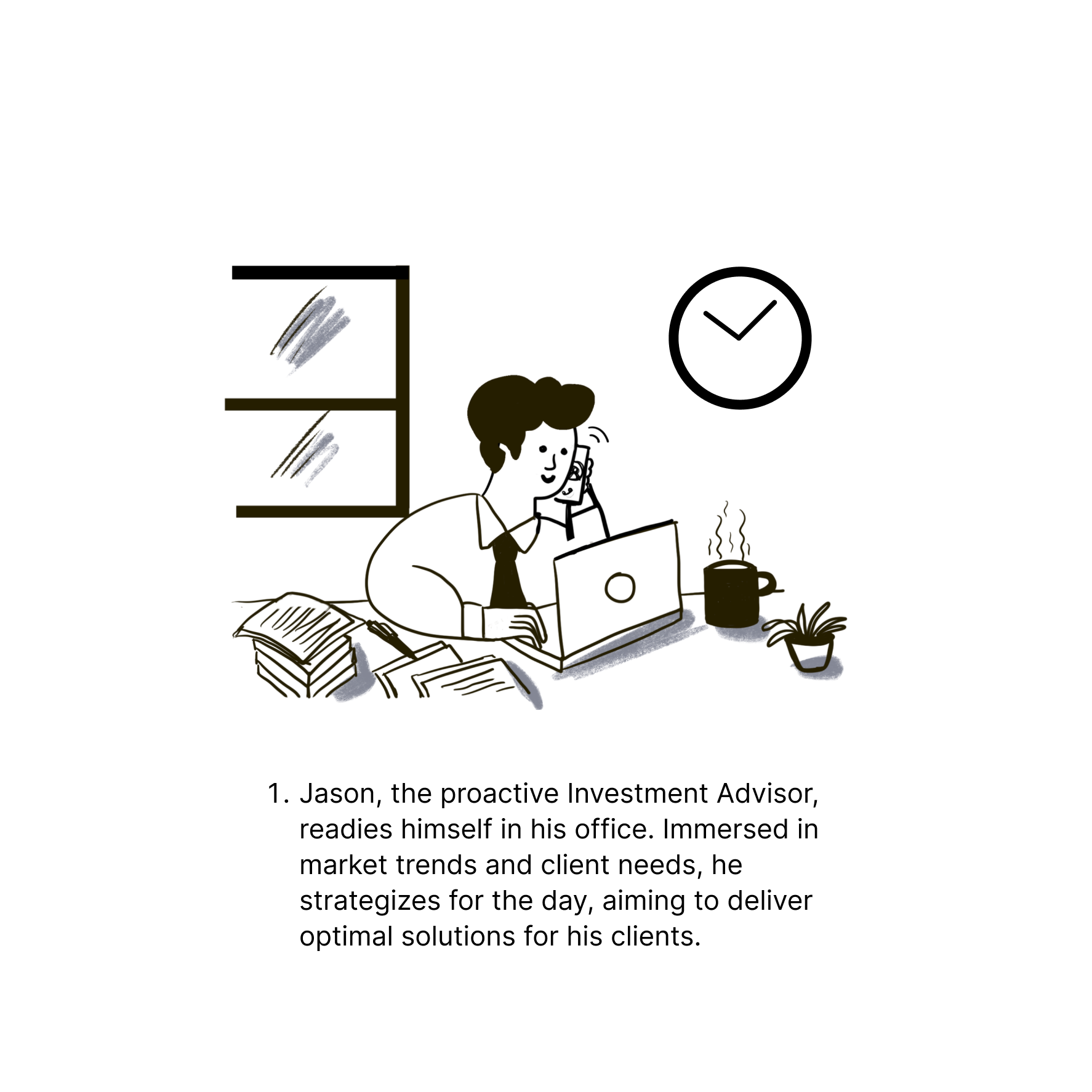
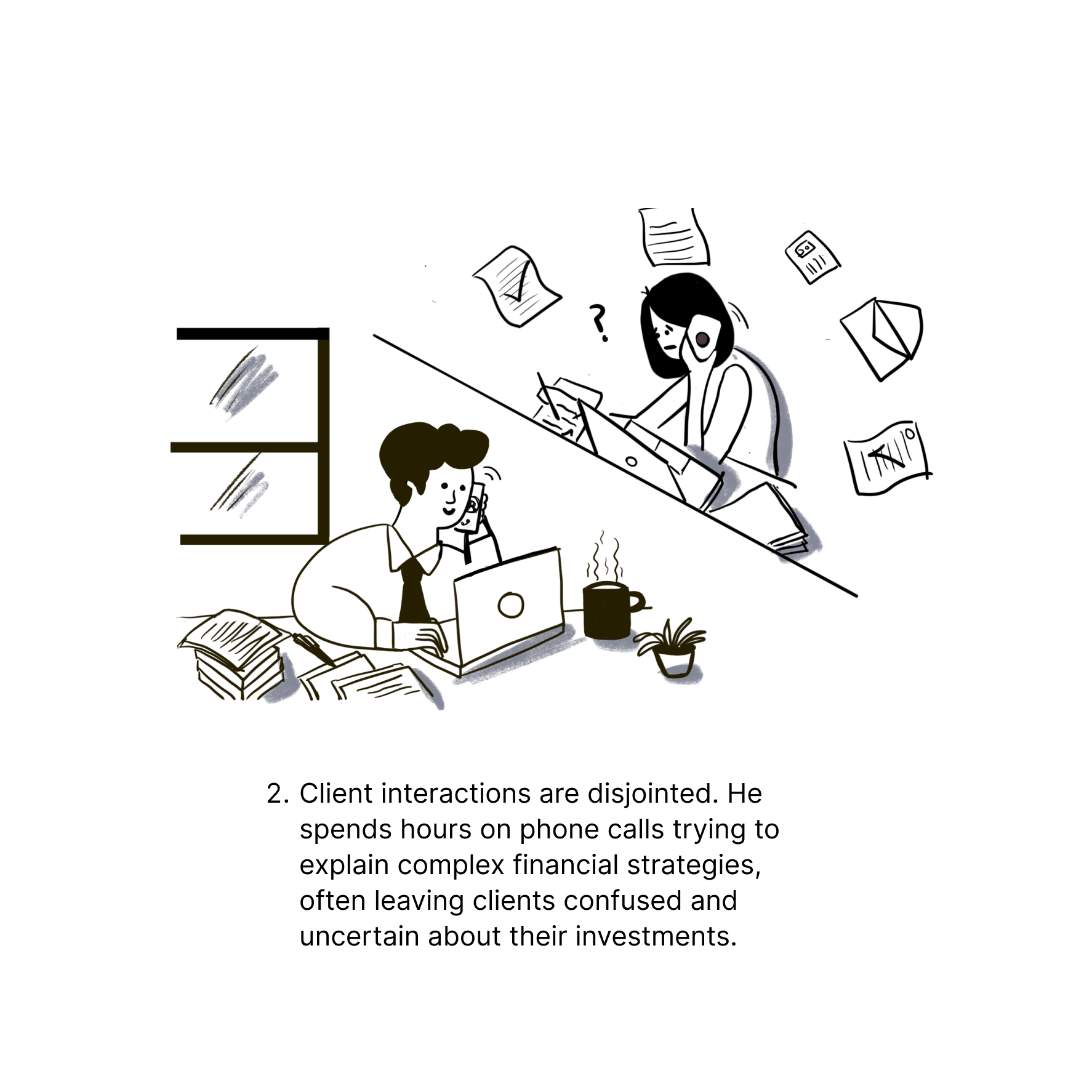
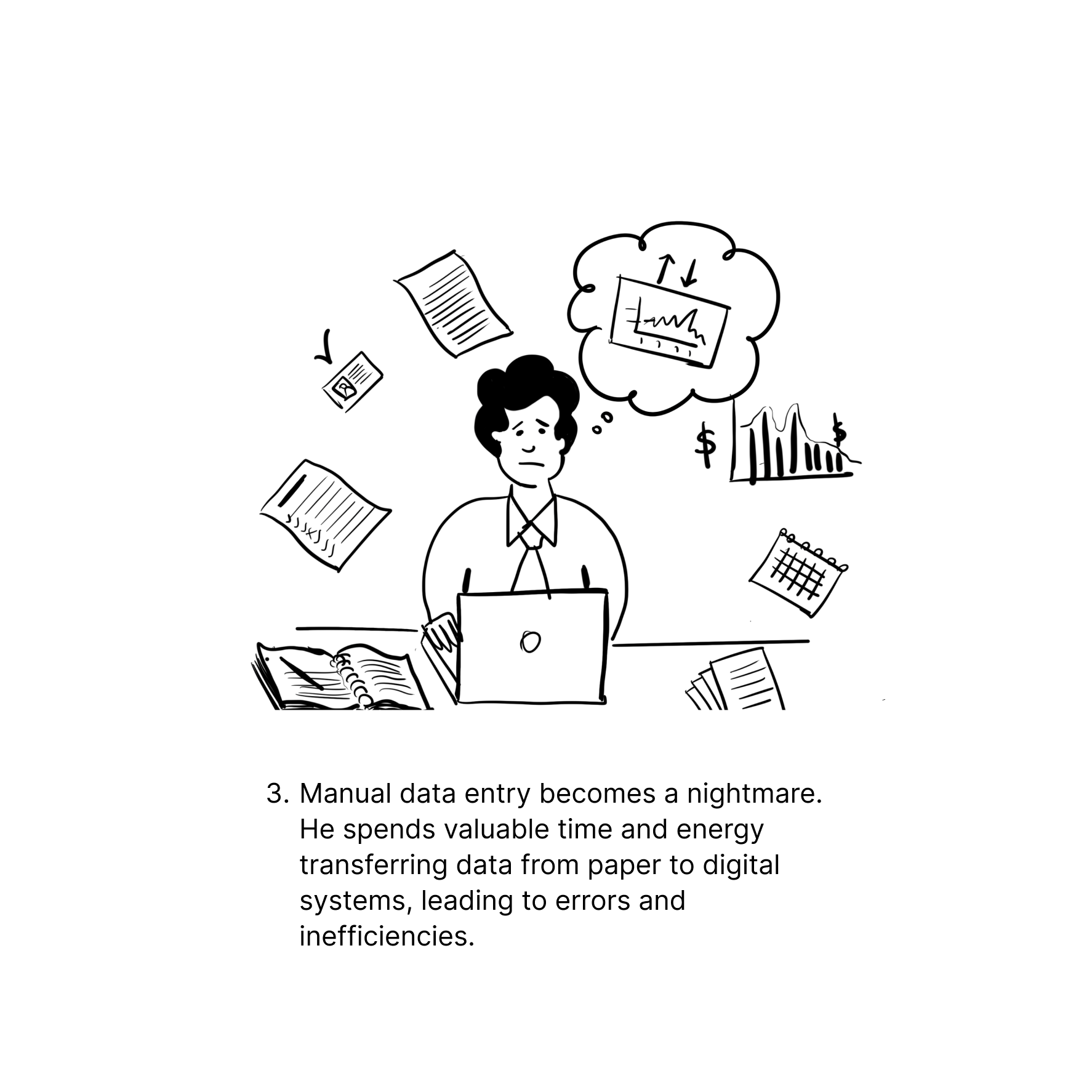
Based on the User Research and Affinity mapping, I focused on the primary user - the Investment advisor. This persona was defined by identifying the common goals, pain points and needs that were discovered during the Secondary Research.
Detailed exploration into user behaviors, workflow analysis, challenges and frustrations
Enhance personas based on additional findings to ensure accuracy and depth in understanding expectations of the user
DEFINING THE MVP
By synthesizing data from user interviews and existing research, a series of targeted brainstorming sessions focused on defining the most essential features. The emphasis was on simplifying client onboarding, enhancing communication, and optimizing portfolio management. Each proposed feature was evaluated against its potential to address user challenges and enhance the overall user experience.
UNVIELING THE USER CENTRIC MVP
Advisor Dashboard: Central hub for streamlined information and actions
Client Management: Effortless client onboarding, KYC processes, and data management
Client Communication: Real-time, direct interaction channels enhancing transparency.
Portfolio Management: AI-driven tools for personalized investment strategies.
Personalization: Tailored investment alignment with individual goals and risk profiles.
03 / Product Ideation
Recognizing the constraints of a limited timeframe, the project strategy prioritized efficiency and user-centricity. Two pivotal tasks were identified to kick-start the ideation process: Adding a new client and Modeling a Custom Portfolio.
We proceeded with these tasks as they represent the core interactions within the platform for both our primary user, the advisor, and his clients. This strategic approach also ensures the vital offering and the business scope are one of our primary focuses. These laid the groundwork for me to work on the User Flows and build a scalable website structure, the Site Map.
STRUCTURING THE WEBSITE AND SITE MAP
Having defined the MVP and outlined the critical website pages and sections, the next step involved shaping and defining the platform architecture. This included mapping out essential pages and establishing a logical flow of information to ensure an intuitive navigation experience for advisors.
CREATING USER FLOWS
Mapping out the steps that the advisor takes to complete a specific task, such as creating a custom portfolio helped in identifying the potential areas of friction or confusion in his journey.
SKETCHES AND WIREFRAMES
I met with stakeholders and clients to define product requirements and desired content for the dashboard.
Once clear, I designed a dashboard focusing on streamlined information flow and architecture.
Financial web platforms can be chaotic and lack focus.
My aim was to create an easy-to-scan, visually appealing information hierarchy.
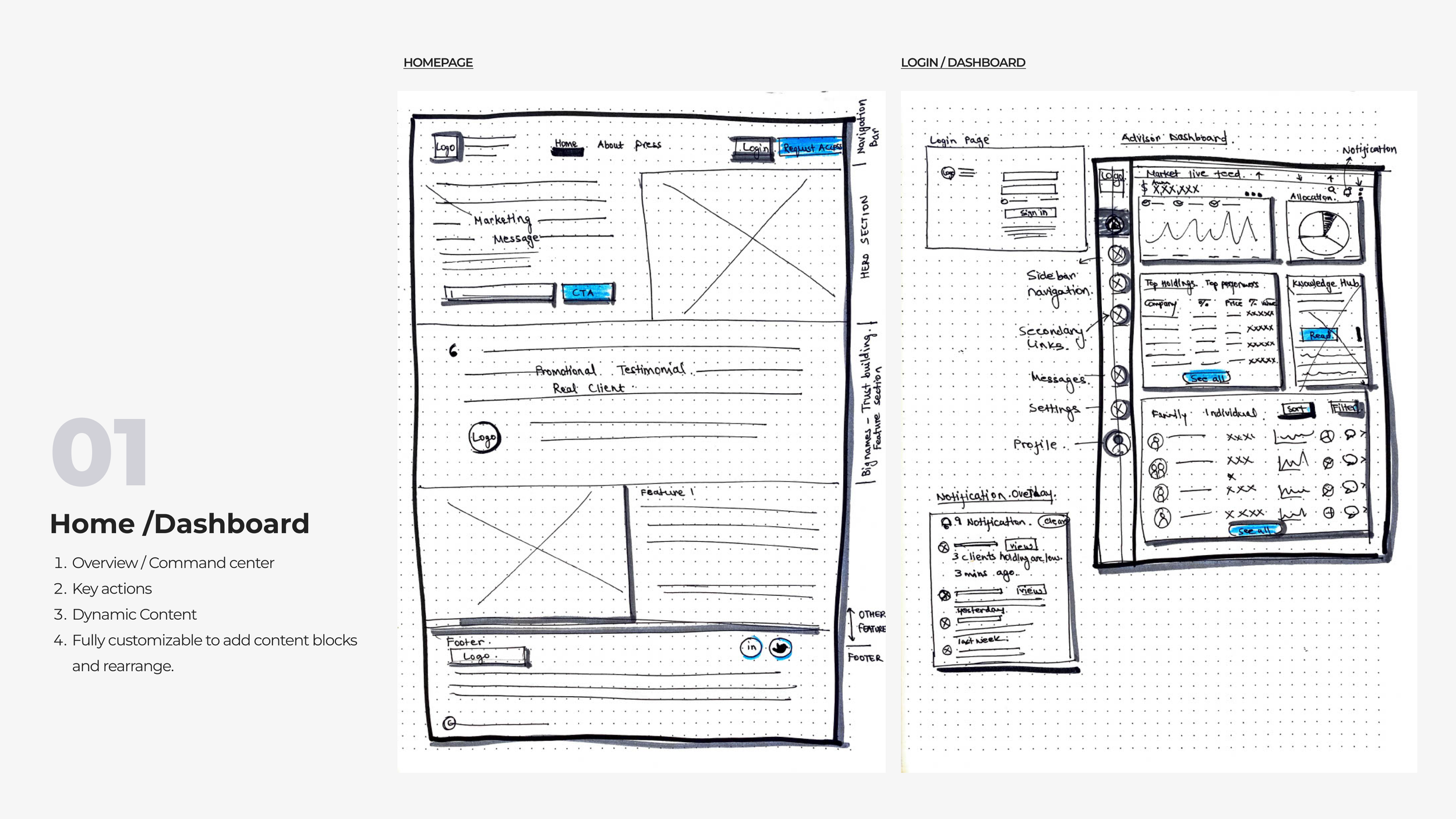
DASHBOARD - The command center for streamlined information and actions
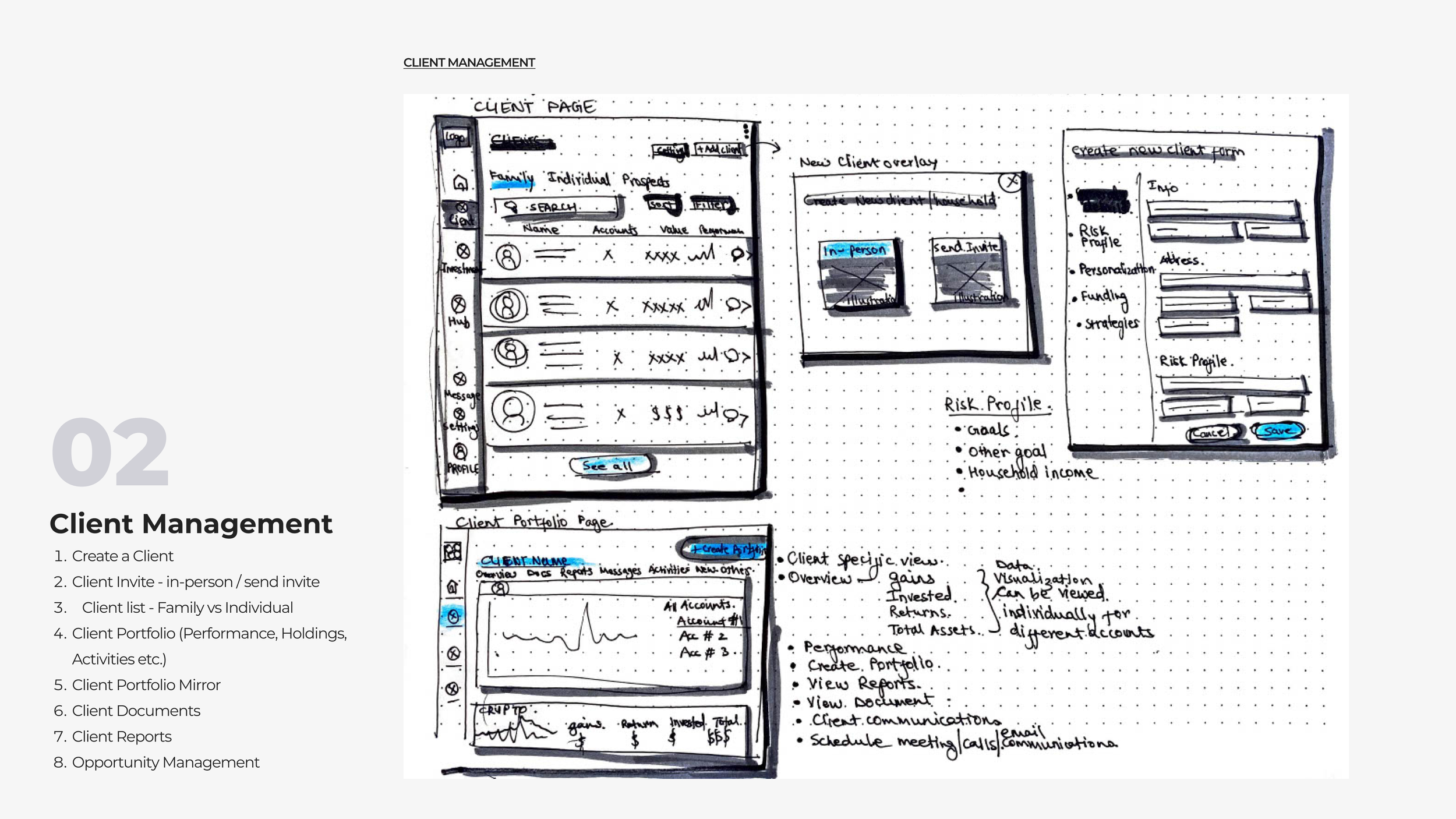
Client Management: Effortless client onboarding, KYC processes, and data management.
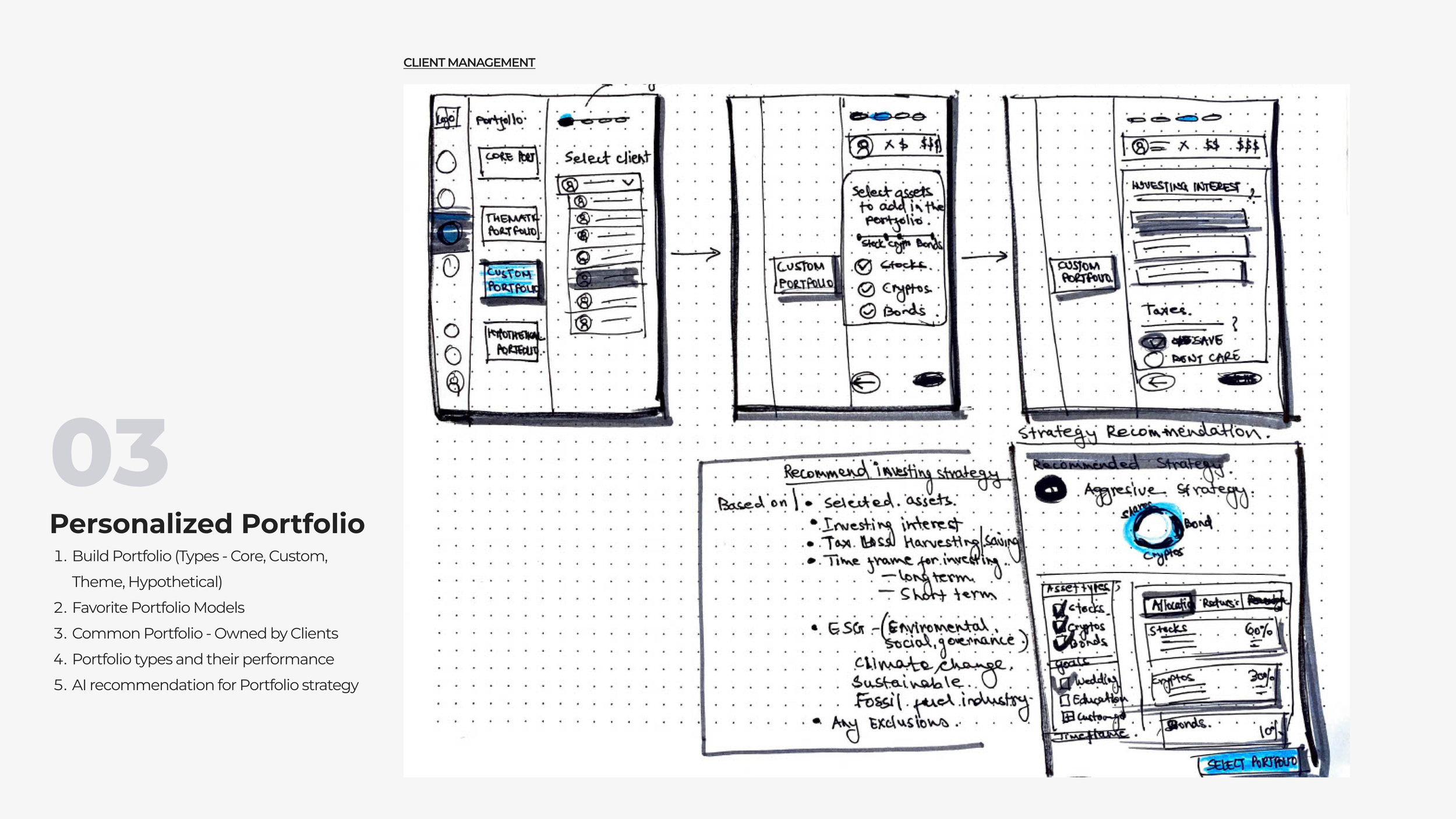
Personalized Portfolio : Tailored investment alignment with individual goals and risk profiles, AI recommendation
MID-FIDELITY WIREFRAMES
It was important to communicate the Information hierarchy and the user flows to the stakeholders before I dived into Visual Design. Due to time constraints, I went directly from sketching to Mid-fidelity Prototype. This not only helped me rethink the amount of information, the scale and flow of the information but also what information can be nested.
I provided a comprehensive walk-through and performed initial prototype testing with stakeholders and select users, resulting in valuable feedback that allowed me to enhance interactions, such as incorporating dropdowns and quick search functionality for client selection.
Visual Design
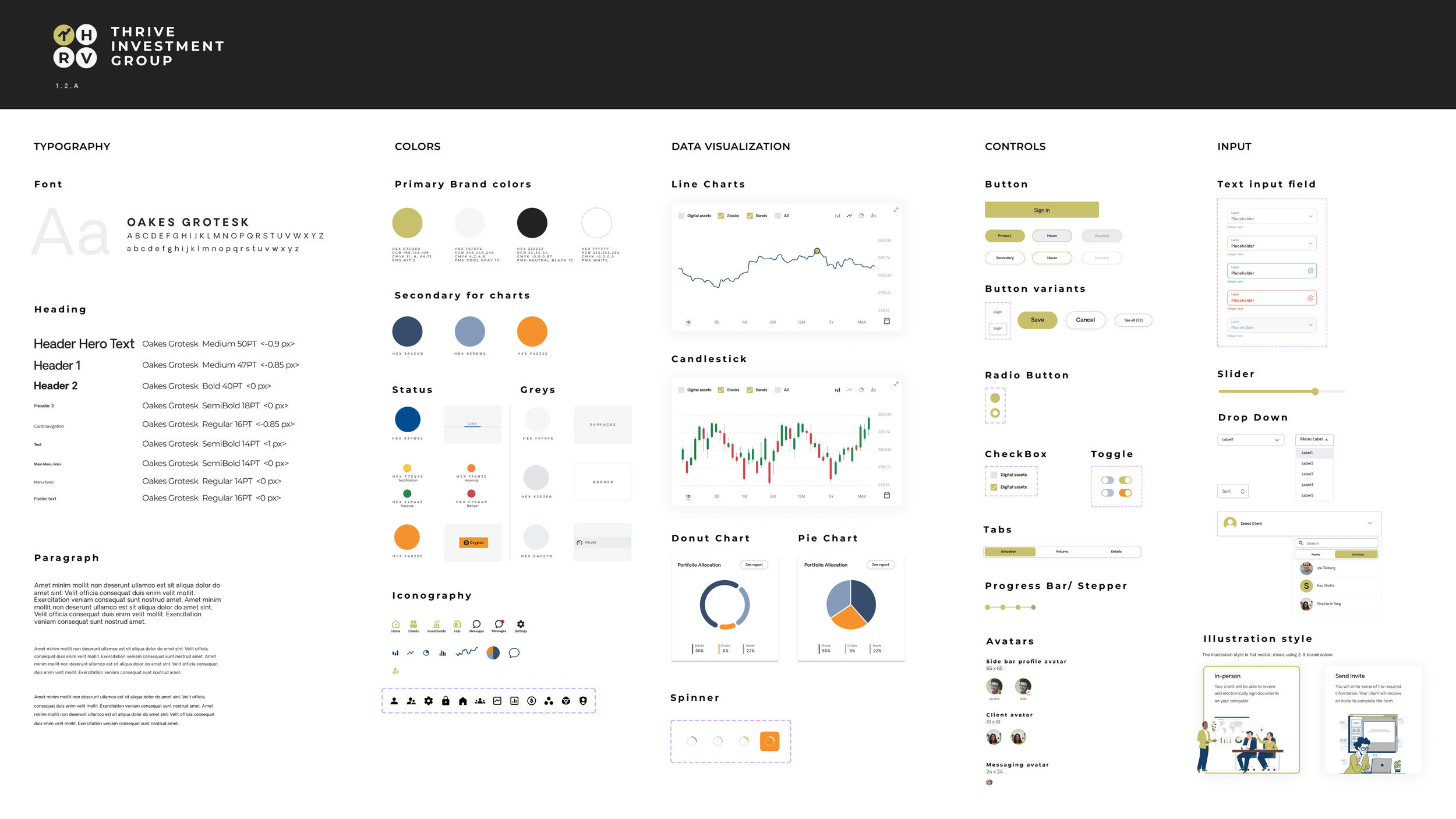
Guided by the branding exploration, I created a detailed UI kit that includes design elements, UI components, and typography choices. I focused on designing Data Visualization elements such as line charts, candlestick charts, pie charts, and donut charts for easy information scanning. The UI kit also contains other key UI elements, including input forms, widgets, buttons, and progress bars. Additionally, it features iconography, illustration styles, and photo styles to improve the overall user experience.
04 / Prototype
After weeks of crafting the content and the look and feel of our platform, it was time to transform our vision into interactive interfaces, concentrating on vital features such as client onboarding and personalized portfolio management. Every detail was methodically designed to ensure a seamless user experience. This phase represented the culmination of our efforts, capturing our concept in tangible form to test it with the users. Each vital element and interaction was thoughtfully designed, anticipating usability testing on key tasks that will follow.
Effortless Client Onboarding
The simplicity of adding a new client, from basic details to KYC completion. Advisors save time, clients enjoy a hassle-free process.
Creating Custom Portfolio
Advisors can build custom portfolios tailored to individual goals. From risk assessment to asset allocation, our intuitive tools redefine personalized wealth management, ensuring tailored financial solutions for every client
05 / Testing the solution
During the Usability Testing Phase, our focus shifted to putting our prototype to the test, ensuring that the user experience lived up to our design expectations. Real users were recruited through combination of recommendation from stakeholders, their current users and few prospective Independent advisors. I conducted these tests through Remote/Moderated via Zoom and through Remote/Unmoderated methods via Maze where the users interacted with the prototype. The observation and test results were instrumental in validating the design decisions, refining user interactions, and fine-tuning the platform to align it more closely with the needs and preferences of our target audience.
TEST OBJECTIVE
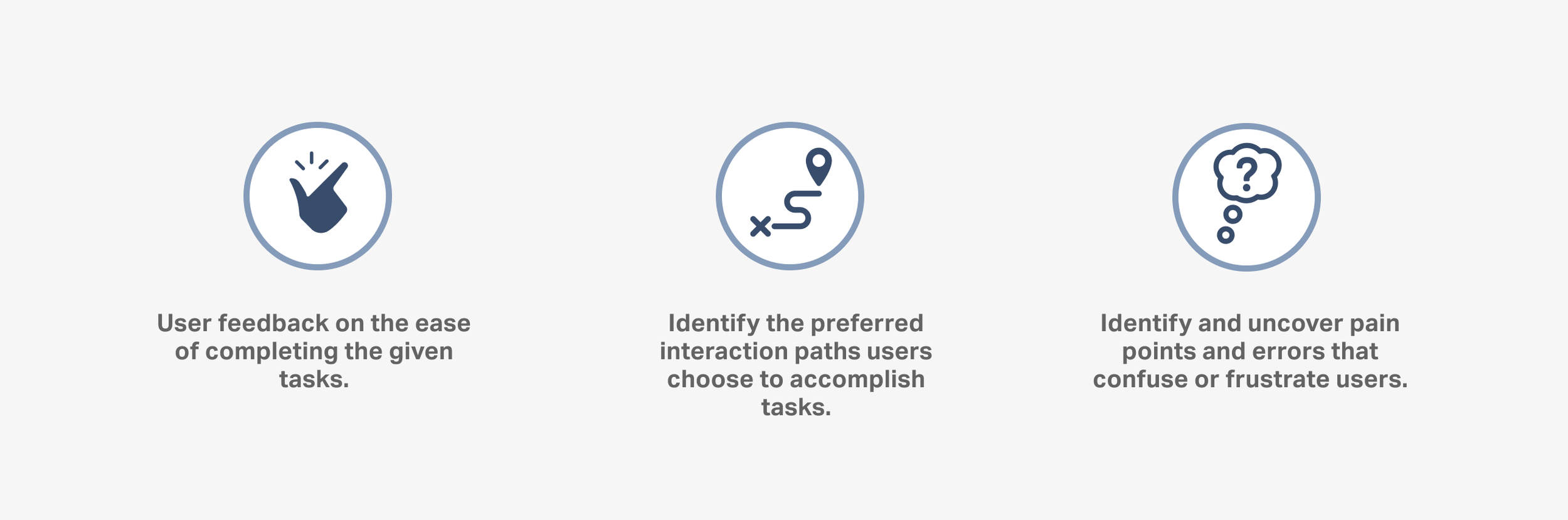
I had initially tested the Mid-fidelity Prototype with the Stakeholders and worked on some information flow and design fixes to the solution. I further conducted a Remote/moderated and Unmoderated qualitative Usability test with a total of 11 participants with an objective to unpack.
TEST RESULTS
The Usability test results validated the solution presented through the BKLN platform. Overall, all the users liked the way the information was structured and expressed that it was very well designed, intuitive, easy to navigate and had a very strong and memorable brand image.
“I appreciate the well-organized dashboard; it helps me keep track of my investments and monitor performance effortlessly.”
“The platform’s user interface is clean and intuitive, making it easy for me to navigate and understand complex financial information.”
“The search function for finding specific investments and clients needs improvement for effective and quick interaction.”
PRIORITY REVISIONS
Although the solution was overwhelmingly validated by the testing participants, there were some genuine user feedback relating to usability and improving the efficiency of search and edit function. With the inputs from the users certain functionalities and actions were revised to enhance the overall product experience.
Revised scale on Icons, labels and Action buttons for better accessibility.
Added Direct Search feature and drop down for quick search for clients
Widget to allocate and distribute percentage investment in asset categories
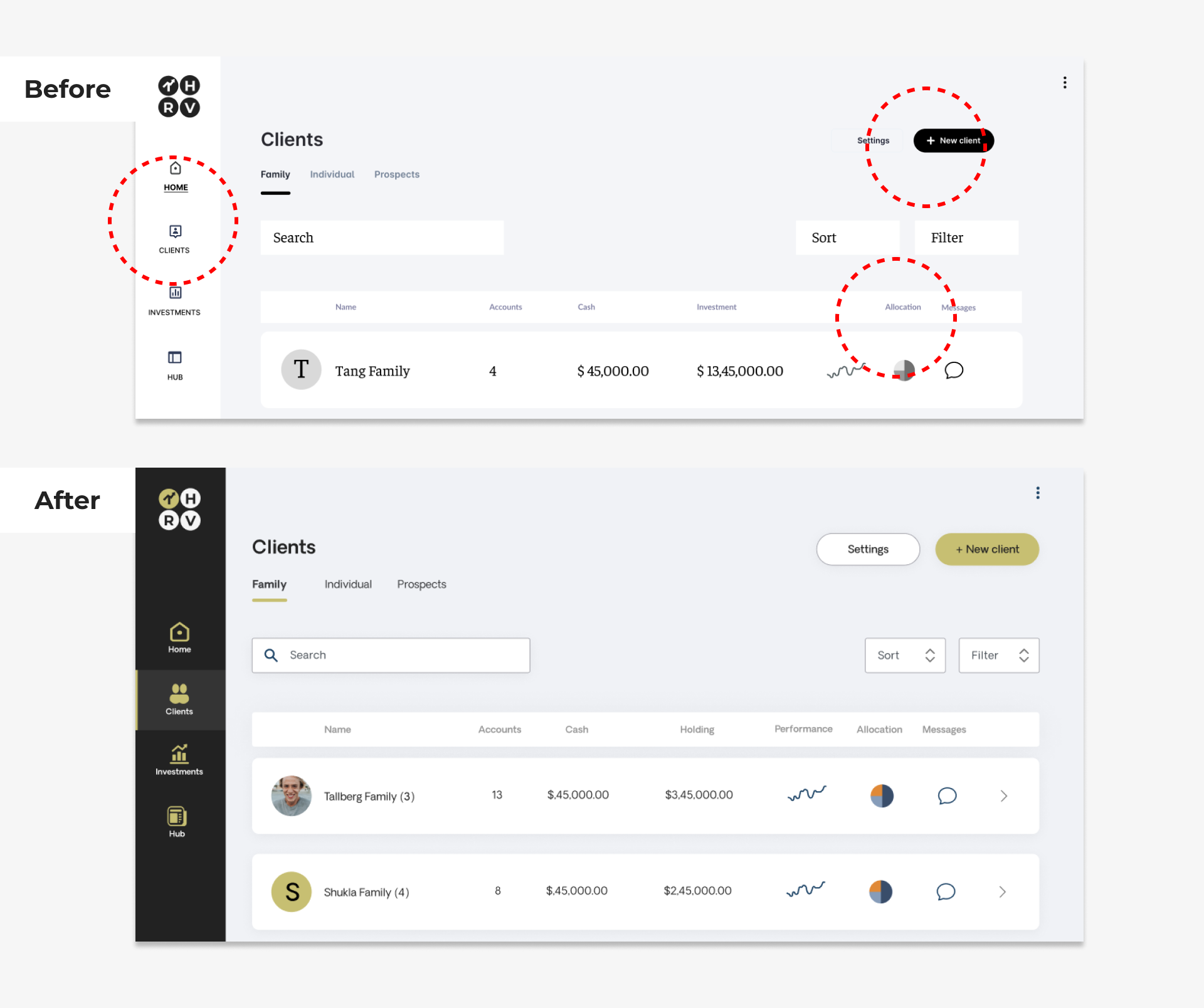
ACCESSIBILITY - Revised scale of design elements: Icons, labels and Action buttons for better Accessibility
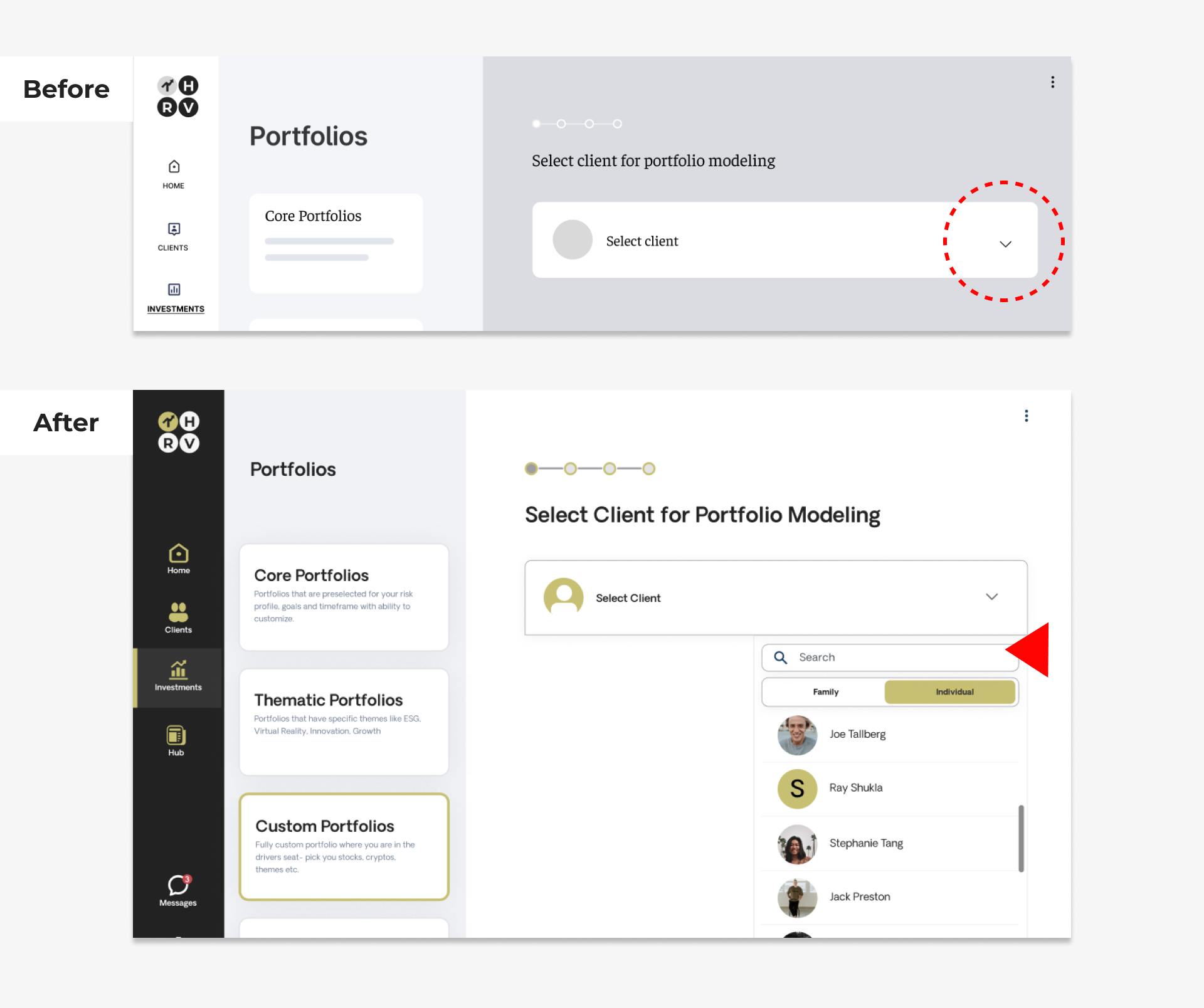
ENHANCED USABILITY - Added Direct Search feature and drop down for quick search for clients. With a growing client list, it could be frustrating to scroll through all the names. The quick search bar avoids the user frustration and intimidation of scrolling back and forth.
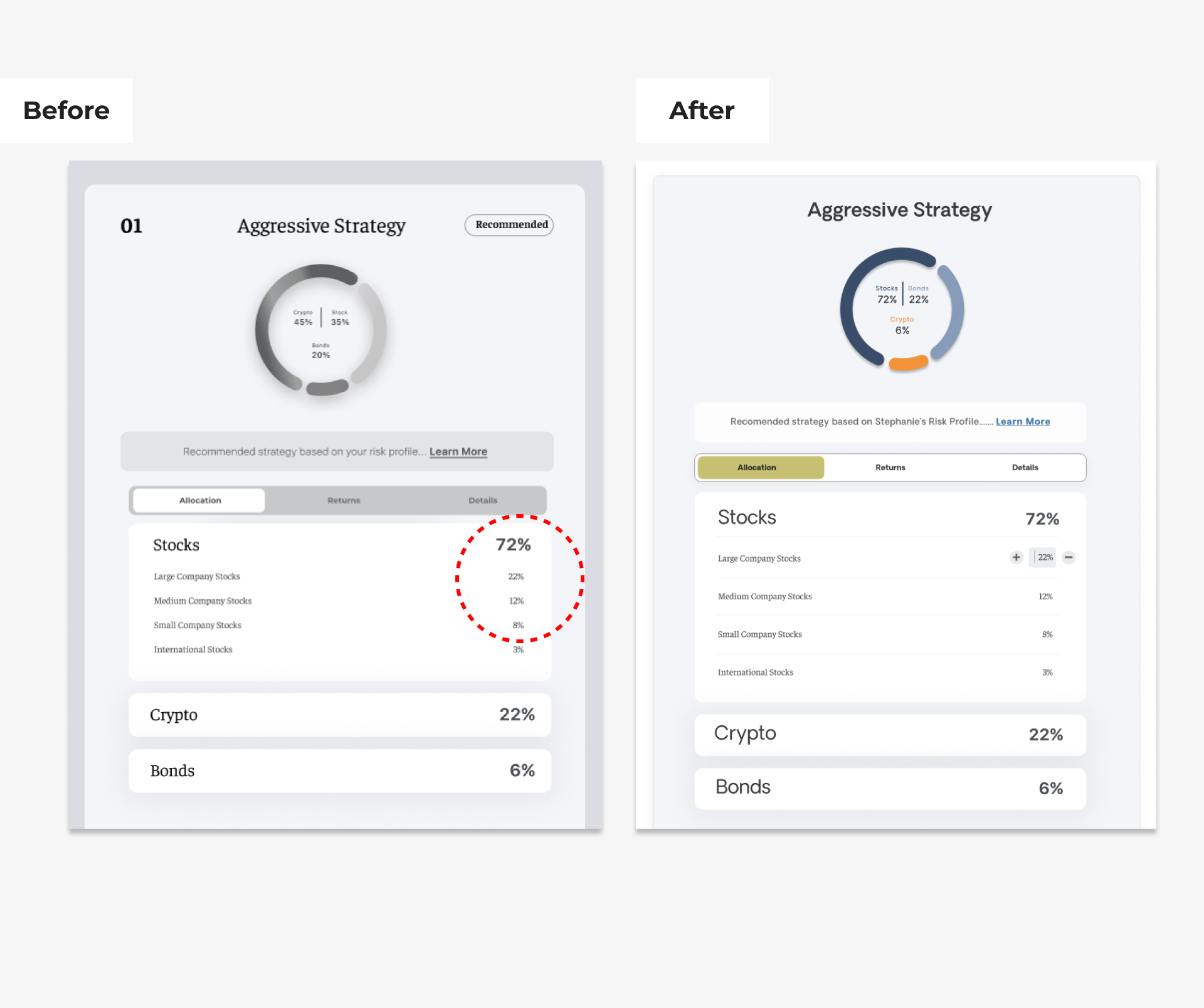
ERROR PREVENTION - Widget to allocate and distribute percentage investment in asset categories. It can be daunting to calculate and recalculate the percentage allocation across the investment portfolio. This number picker widget helps reduce the cognitive load and prevents error by helping the user allocate and distribute the percentage investments across the categories.
KEY LEARNINGS
By actively involving financial advisors throughout the design process, we learned the importance of continuous user involvement. While usability tests provided valuable insights, including advisors in design reviews, concept validation, and prototype testing enriched our understanding and ensured a more user-centric approach.
Engaging advisors yielded contextual feedback, aligned our solutions with their needs, and uncovered usability issues. This iterative involvement enabled us to fine-tune designs for a more intuitive user experience.
In summary, our key learning is that continuous user involvement, particularly with financial advisors, is crucial for gathering rich insights and creating solutions that meet user needs. Going forward, we will prioritize advisor engagement to enhance user satisfaction and success.